
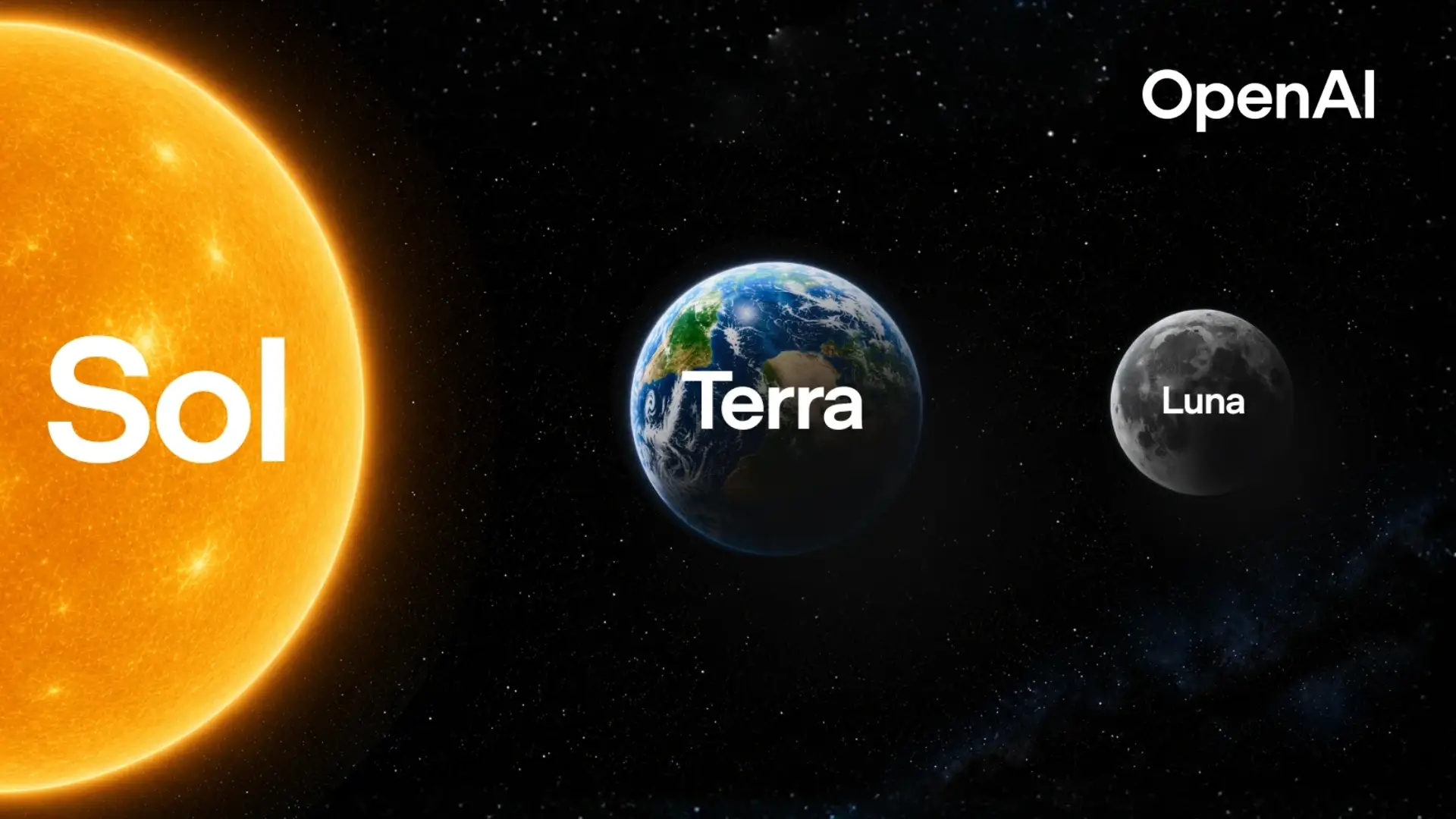
OpenAI has begun a limited preview of its GPT-5.6 model family, introducing Sol as its new flagship system alongside Terra and Luna variants aimed at different performance and cost tiers. The company describes Sol as its strongest model to date, with a focus on more complex “agentic” workloads spanning coding, biology and cybersecurity, while Terra targets everyday work at roughly half the cost of GPT-5.5 and Luna is positioned as a faster, lower-priced option with “strong capability” at the bottom of the range.
The new series debuts with what OpenAI calls its most robust safety stack so far, reflecting growing concern over models that can assist with sensitive cyber operations. GPT-5.6 adds a max reasoning mode, which gives Sol more time to handle difficult problems, and an ultra mode that orchestrates sub-agents to speed up complex multi-step tasks beyond the capabilities of a single model instance. On internal benchmarks, OpenAI reports that GPT-5.6 Sol and Sol Ultra set a new high-water mark on Terminal‑Bench 2.1, a command-line coding benchmark that measures planning, iteration and tool coordination, outperforming both its own GPT‑5.5 and rival systems from Anthropic and Google.
OpenAI also highlights gains in scientific and security-oriented workloads. On GeneBench v1, a genomics and quantitative-biology benchmark, GPT‑5.6 Sol is said to achieve stronger scores than GPT‑5.5 while using fewer output tokens, indicating more efficient long-horizon analysis. In cybersecurity, the company says GPT‑5.6 Sol shifts the “performance-efficiency frontier” on ExploitBench and delivers improved results on ExploitGym, suggesting it can handle more advanced vulnerability research and exploitation tasks with fewer tokens than previous models and frontier competitors.
Those cyber capabilities sit at the center of OpenAI’s deployment strategy for GPT‑5.6. The company argues that Sol is more effective at helping users find and fix vulnerabilities than at reliably carrying out end‑to‑end attacks, and says the model does not cross the “Cyber Critical” threshold set in its Preparedness Framework because it did not autonomously generate full-chain exploits in tests on Chromium and Firefox. Even so, OpenAI acknowledges benchmark thresholds cannot capture all real-world uses or tool combinations, and it is pairing the new capabilities with both stronger safeguards and a phased release.
Safeguards operate in multiple layers, starting with model-level refusals that are trained to block prohibited cyber assistance, including user attempts to disguise malicious intent or jailbreak the system. Additional real-time classifiers scan outputs for cyber and biological misuse, pausing responses in higher-risk cases so a larger reasoning model can review context and withhold content deemed disallowed, while flagged activity can trigger account-level review across conversations and risk signals. OpenAI notes that these protections may cause delays or false positives, particularly for dual-use security work, and says feedback from the preview will be used to reduce unnecessary blocks and refine how safeguards interpret context.
The company also invested heavily in testing defenses before launch, dedicating more than 700,000 A100-equivalent GPU hours to automated red-teaming designed to uncover “universal jailbreaks” that can generalize across prompts. That effort is complemented by third-party human expert red-teaming and a rapid-response process to reproduce and patch newly discovered attacks, which are then folded into ongoing evaluations
For now, access to GPT‑5.6 Sol, Terra and Luna is restricted to select partners and organizations via API and Codex, under an approach OpenAI says was coordinated in advance with the U.S. government. The company states it does not want this form of pre-release government access to become the long-term default, but frames it as a short-term step while it works with the administration on a cyber-focused executive order framework and a repeatable process for future model releases. Broader availability to ChatGPT, Codex and general API users is planned “in the coming weeks,” with Sol, Terra and Luna priced at 5 dollars, 2.50 dollars and 1 dollar per million input tokens respectively, and 30 dollars, 15 dollars and 6 dollars per million output tokens. GPT‑5.6 also introduces more predictable prompt caching, and OpenAI plans to launch Sol on Cerebras in July at up to 750 tokens per second for selected high-throughput customers.
Read Article: Google Cloud Adds Cross-Region Backups to Backup and DR Service