
The Myth of Product-Led Success
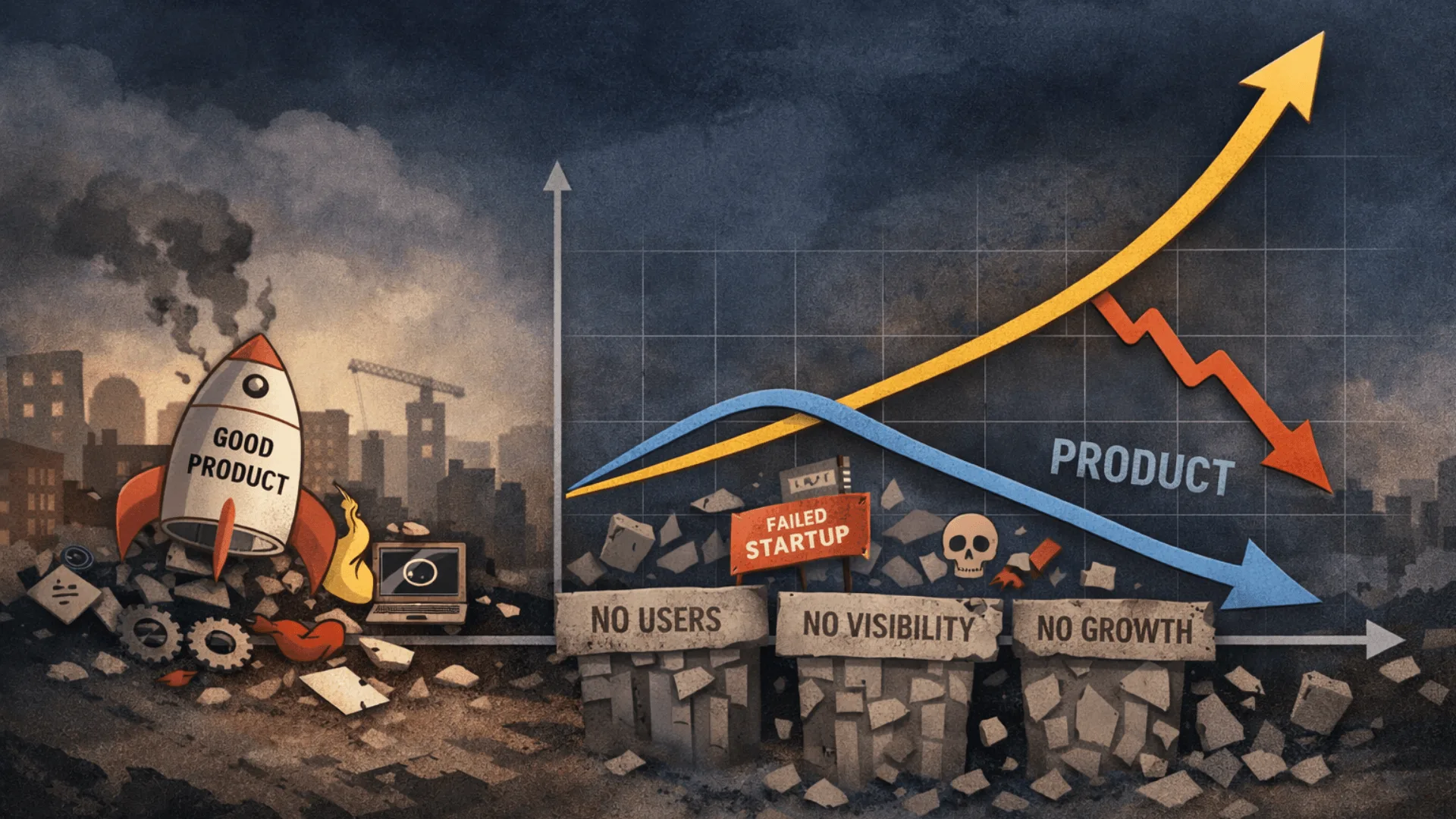
There is a silent graveyard of well-built products that never found users. Not because they were bad, but because they were invisible.
Founders often spend months, sometimes years, refining features, improving UI, and chasing perfection. But when the product finally launches, it enters a crowded market with no attention, no audience, and no clear path to reach users.
The assumption that “good products sell themselves” is one of the most expensive myths in startups.
 AI Has Changed the Game
Artificial intelligence has fundamentally altered how products are built.
Today, a small team, or even a solo founder, can:
-
- Build full-stack applications using AI tools
-
- Generate UI/UX designs instantly
-
- Integrate complex APIs in days instead of months
In short, product development is no longer the bottleneck.
This shift has created a new reality:
When everyone can build, building is no longer the advantage. Distribution is.
The Real Moat: Attention
Products can be replicated. Features can be copied. Pricing can be undercut.
But attention is scarce. And whoever controls attention controls growth.
The most successful startups today are not always the ones with the best products. They are the ones with the strongest distribution engines:
-
- Founders who consistently create content
-
- Brands that dominate social platforms
-
- Companies that build communities, not just customers
They understand a simple truth: if people don’t see you, you don’t exist.
The Distribution Gap in Indian Startups
India is producing an unprecedented number of startups. The quality of engineering talent is high, and access to tools has never been better.
Yet, many startups struggle to scale beyond a point.
The reason is not always product-market fit. It is often a lack of visibility.
Weak storytelling, limited branding, and almost no structured distribution strategy hold back otherwise strong products. Many founders still treat marketing as a post-launch activity rather than a core function.
In a world driven by content and algorithms, that approach no longer works.
 Paid Growth Is Not a Strategy
When startups realize they lack traction, the default response is to turn to paid ads.
While this can deliver short-term results, it rarely builds a sustainable foundation. Customer acquisition costs rise, margins shrink, and growth becomes dependent on continuous spending.
Without organic distribution, startups are renting attention instead of owning it.
Content Is the New Infrastructure
The most underappreciated shift in this decade is the rise of content as a primary growth driver.
Founders are no longer just operators. They are becoming creators, storytellers, and distribution engines themselves.
A single LinkedIn post can generate:
-
- Users
-
- Partnerships
-
- Investor interest
A strong content strategy can do what large marketing budgets cannot.
In many ways, content is becoming the new infrastructure layer for startups.
Building Distribution from Day One
The old model was simple:
Build → Launch → Market
The new model is different:
Build and Distribute simultaneously
Startups that succeed in this environment:
-
- Build in public
-
- Engage early users
-
- Create communities
-
- Share their journey consistently
They don’t wait for the product to be perfect before telling their story.
 The Future of Product Building
As AI continues to reduce the cost and complexity of building products, the gap between ideas and execution will shrink even further.
What will differentiate startups is not what they build, but how effectively they distribute it.
The future belongs to companies that can combine:
-
- Fast product development
-
- Strong storytelling
-
- Scalable distribution systems
In this new era, distribution is not a support function. It is the core strategy.
The Shift No One Is Talking About
We are entering a phase where:
-
- Products are abundant
-
- Attention is limited
And yet, much of the startup advice still revolves around building.
Very few conversations focus on distribution with the same intensity.
That gap is where most failures are happening.
Startups don’t fail because they build bad products.
They fail because no one knows they exist.
And in the age of AI, that gap between creation and visibility is only going to widen.