
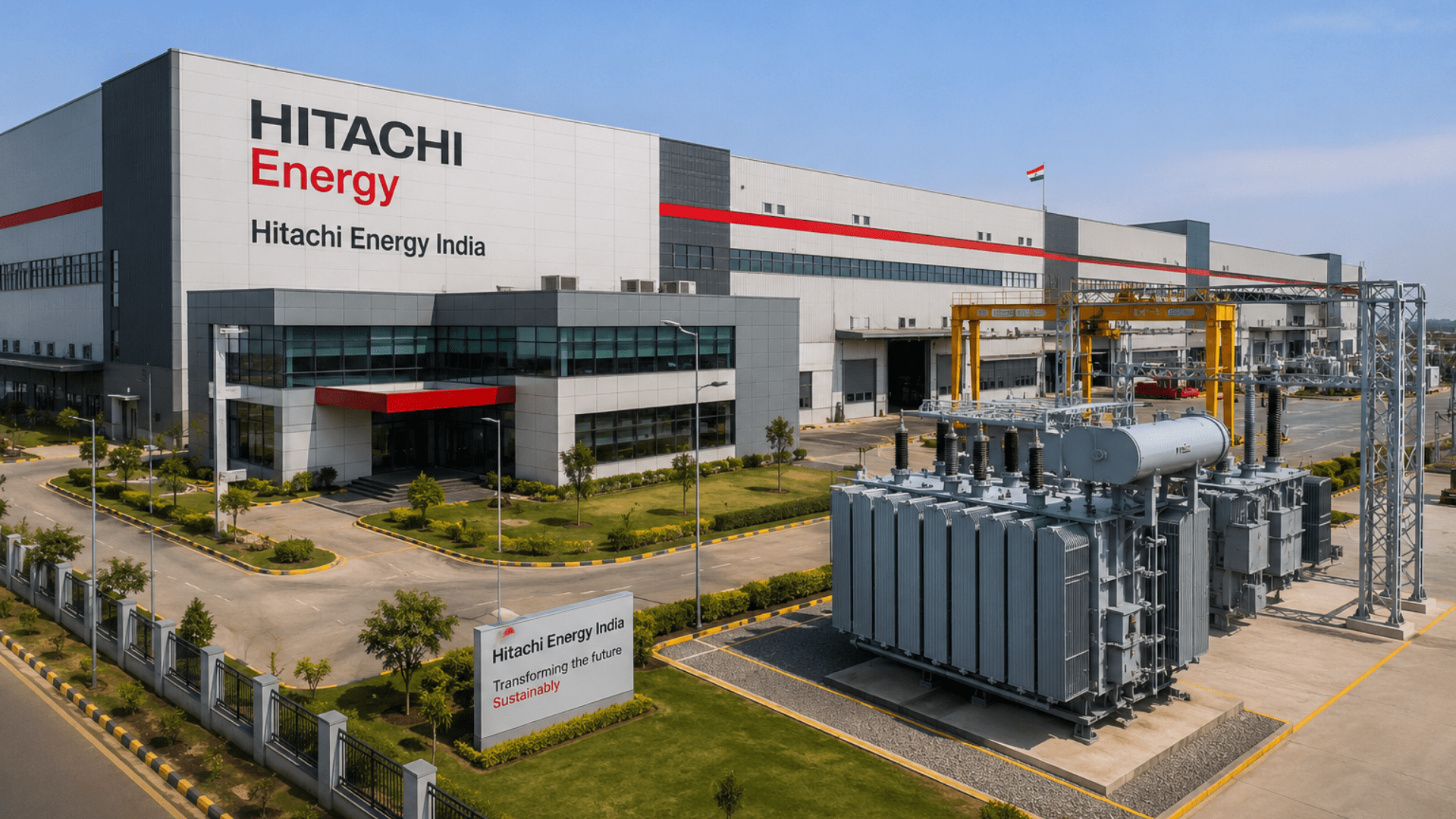
Hitachi Energy India is deepening its presence in the country’s power equipment landscape with a ₹2,000 crore commitment to build a Large Power Transformer (LPT) facility in Karjan, Vadodara. Disclosed in a regulatory filing on Friday, the project ranks among the most significant capital deployments in India’s power equipment industry in recent months.
The Japanese multinational, part of Hitachi Group, framed the investment as a long-term bet on India’s rising electricity consumption and its growing role in global supply chains. With India’s power demand expected to climb by 8-10% annually through 2030, the Karjan plant is intended to anchor Hitachi Energy’s contribution to the country’s next phase of grid expansion and reliability upgrades.
Karjan has emerged as a power manufacturing cluster, already hosting facilities of ABB, Siemens, and Bharat Heavy Electricals Limited (BHEL). By locating its LPT factory in this industrial hub, Hitachi Energy will plug into an established ecosystem of suppliers, engineering talent, and logistics infrastructure focused on high-voltage equipment.
The new plant is explicitly aligned with the government’s “Atmanirbhar Bharat” (Self-Reliant India) agenda, which calls for domestic production of strategically important power assets. Data from the Ministry of Power indicates that India still imports around 15-20% of its large power transformers, largely sourced from China, South Korea, and Sweden. Localising that capacity is becoming a policy priority as grid expansion accelerates.
Industry projections suggest the Indian power transformer market could reach ₹45,000-50,000 crore by 2027, supported by a compound annual growth rate of 9-11%. Grid reinforcement, renewable energy integration, and industrial electrification are all contributing to sustained demand for large power transformers, positioning manufacturers to benefit from multi-year order pipelines.
Hitachi Energy plans to use the Karjan factory not only to address Indian utilities and industrial customers, but also as a regional export base. The site is expected to serve markets across South Asia, Southeast Asia, and the Middle East, allowing the company to leverage India’s cost competitiveness and skilled engineering workforce against established rivals in China and Europe.
The company already operates several Indian manufacturing locations, including plants in Pune, Bangalore, and Hyderabad, together employing more than 3,500 people. The Karjan investment adds another pillar to this footprint, signalling confidence in India as a long-term manufacturing and engineering hub for grid technologies.
From Tokyo, the company’s global headquarters reiterated that India remains a “strategic priority” for its power systems portfolio. The latest investment underscores that positioning, tying together domestic policy goals, regional export ambitions, and the broader shift toward more resilient and diversified global supply chains for critical electrical infrastructure.