
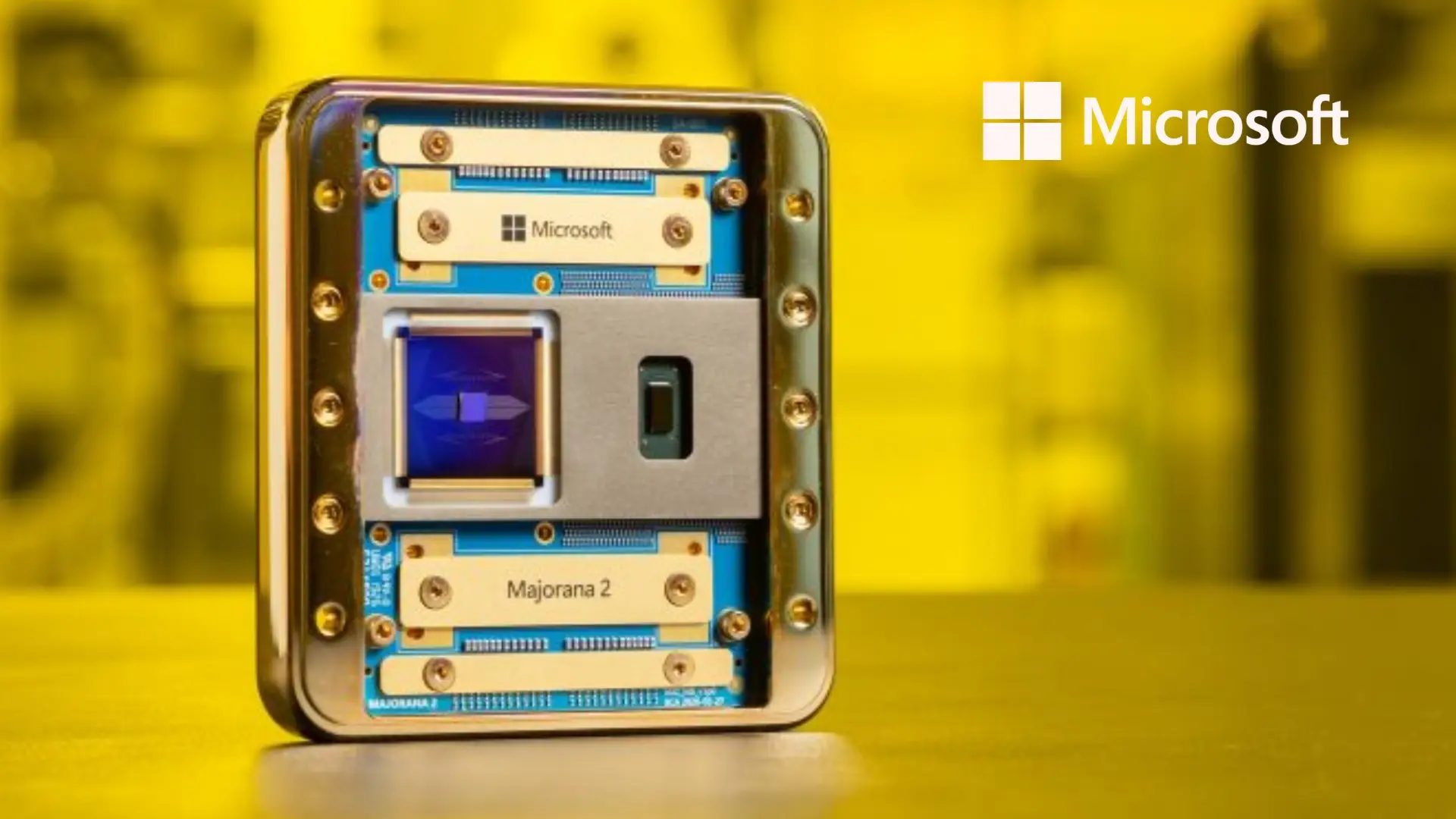
Microsoft has announced Majorana 2, a next-generation quantum computing chip that delivers a 1,000-fold improvement in qubit reliability over its predecessor, marking a significant step toward its goal of delivering a commercially useful quantum computer by 2029. The breakthrough was unveiled at the Build developer conference in San Francisco, where the company shared new performance data and accelerated its quantum computing timeline.
The qubits in Majorana 2 exceed 20 seconds of parity lifetime, compared to the one-to-12 millisecond range achieved by Majorana 1’s aluminum-based qubits introduced in February 2025. This leap in performance stems from a redesigned material stack incorporating lead and antimony, along with refined fabrication processes that more than doubled the topological gap a critical parameter for Majorana-based qubits.
Microsoft’s Azure Quantum team, led by Chetan Nayak, emphasized that the reliability gains address earlier skepticism about the company’s topological qubit approach. The topological design aims to create inherently stable qubits that resist environmental noise, a persistent challenge in quantum computing.
The chip’s development leveraged Microsoft’s Discovery platform, an agentic AI system designed to accelerate materials research. The company announced it will open Discovery to external researchers starting Tuesday, signaling a broader strategy to combine AI and quantum computing capabilities. This convergence represents two of Microsoft’s largest technology investments, with AI agents exploring material combinations and optimizing fabrication faster than traditional methods.
Microsoft now expects to deliver a scalable topological quantum computer by 2029, a timeline described as much earlier than originally anticipated. The announcement comes just days after IBM announced it would invest more than $10 billion over five years to build a large-scale quantum computer by the same target year, according to Reuters.
Initial tests of Majorana 2 suggest additional performance gains are possible, though Microsoft has not yet characterized the chip’s full capabilities. The broader physics community continues to evaluate whether Microsoft’s topological claims meet rigorous scientific standards, but the quantum computing race now has at least two well-funded competitors targeting the 2029 milestone.
The Majorana 2 announcement positions Microsoft as a serious contender in quantum computing, alongside IBM, Google, and other technology giants investing heavily in the field. Quantum computers promise to solve certain problems exponentially faster than classical systems, with potential applications in cryptography, drug discovery, financial modeling, and materials science.
Read Article: ONDC Raises ₹220 Crore from Zoho, Uber, Paytm and BSE Technologies