
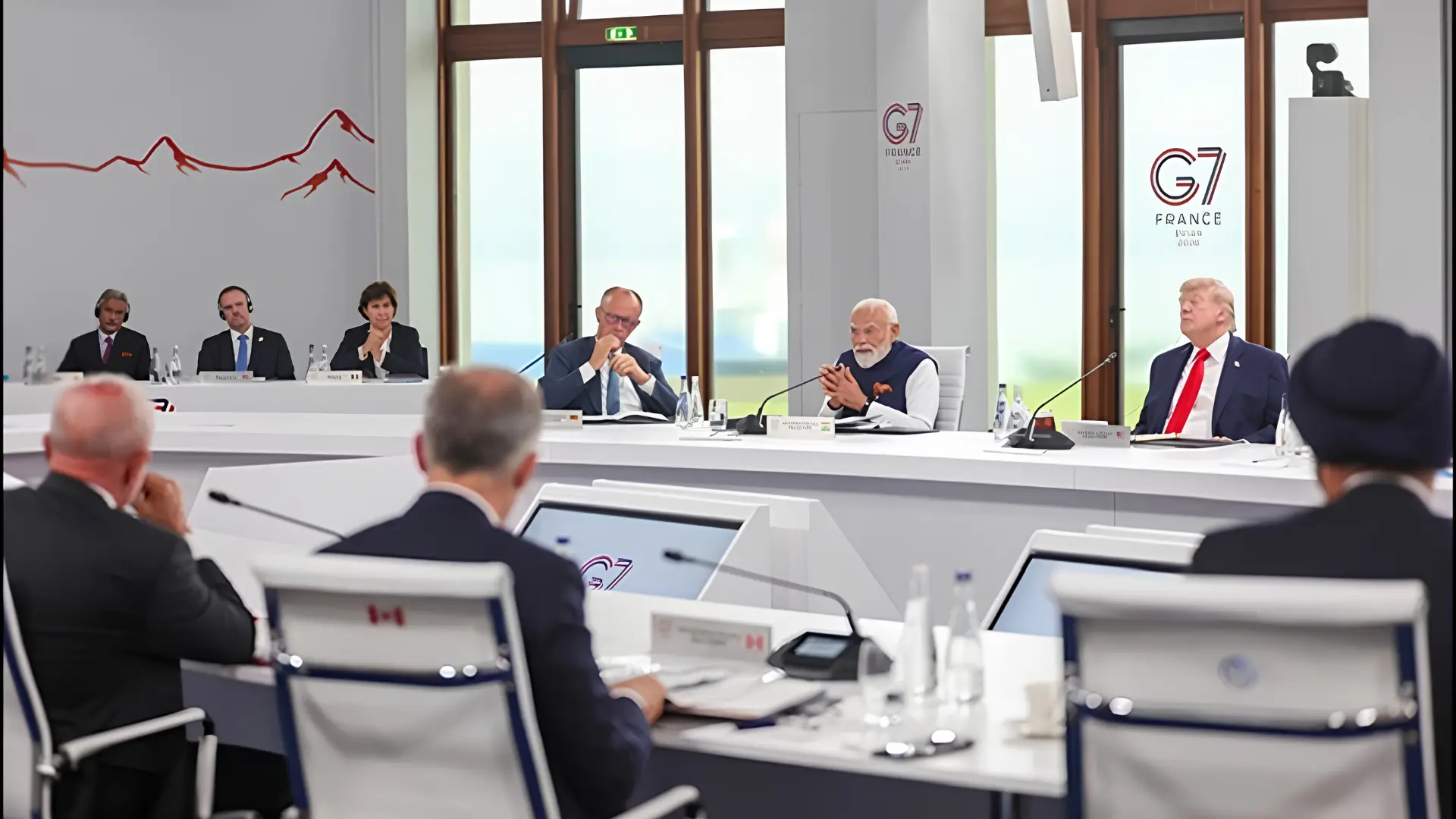
Addressing the Outreach Session on “Ensuring a Safe, Rapid and Efficient Rollout of Artificial Intelligence” at the G7 Summit in Evian, France, Prime Minister Narendra Modi framed artificial intelligence as a powerful technology that could reorganize human civilization, but insisted it must always advance human welfare rather than displace or diminish people. He highlighted India’s recent AI Impact Summit as an example of a human-centered, MANAV vision for AI that anchors innovation in inclusivity, security and the wider public interest.
Modi positioned cyberspace itself as a global public good and argued that democratic nations require reliable access to AI models capable of defending critical information infrastructure and countering increasingly sophisticated cyber threats. He pushed for a holistic view of AI development in which safety, speed and efficiency reinforce one another instead of being treated as trade-offs that slow deployment or weaken protections.
The Prime Minister laid out four priorities for responsible AI governance. First, he called for systems that are “safe by default”, with protections embedded at the design stage rather than bolted on later. Second, he stressed the need to pair deployment with coherent standards, interoperable testing frameworks and clear regulatory guidance so that both governments and industry can evaluate risks consistently. Third, he urged stronger global cooperation to tackle deepfakes, misinformation and AI-enabled cyber fraud. Finally, he emphasized that AI’s economic and social gains must extend to the Global South, supporting inclusive development instead of widening structural gaps.
These proposals came against a backdrop of rapidly escalating AI-driven abuse. The explosion of synthetic media since 2019, with multi-fold increases in detected samples, has fed a surge in deepfakes that target both individuals and institutions. Tens of thousands of business-email-compromise (BEC) complaints are lodged annually, while estimates place global cybercrime costs in the hundreds of billions to trillions of dollars once indirect damage is counted, from operational disruption to reputational harm.
Generative models have sharply lowered the expertise required to fabricate convincing audio, video and text, allowing attackers to industrialize phishing campaigns, deepfake-enabled scams and extortion schemes. Industry trackers cite ransomware payouts and remediation expenses in the high hundreds of millions to low billions of dollars in the 2021–2023 period, illustrating the scale of the threat. At the same time, academic and platform monitoring initiatives documented steep growth in deepfake content through 2023–2024, underscoring the challenge for both regulators and platforms.
This convergence of generative AI capabilities with long-standing fraud methods is now outpacing existing detection tools and governance regimes. The widening defense gap especially harms under-resourced institutions in both wealthier economies and the Global South, which often lack advanced security operations centers, skilled analysts or resilient digital infrastructure. Eroding trust in digital systems, Modi suggested, threatens public confidence, democratic discourse and economic resilience.
To close that gap, he urged policymakers and technology companies to harden AI systems through safe-by-design standards, invest in interoperable testing and detection frameworks, and deepen international collaboration on cross-border takedowns, intelligence sharing and investigations. He linked these measures directly to capacity-building in the Global South, arguing that support for infrastructure, skills and governance is essential if countries are to capture AI’s benefits without bearing disproportionate harm.
Modi concluded by reiterating that artificial intelligence should expand human capability, preserve meaningful choice and uphold human dignity. He pledged that India will continue working with global partners to pursue governance models and technical standards that secure these aims while keeping AI firmly aligned with the public good.
Read Article: India Tech Recruitment Tightens as Openings Sink and Layoffs Rise