
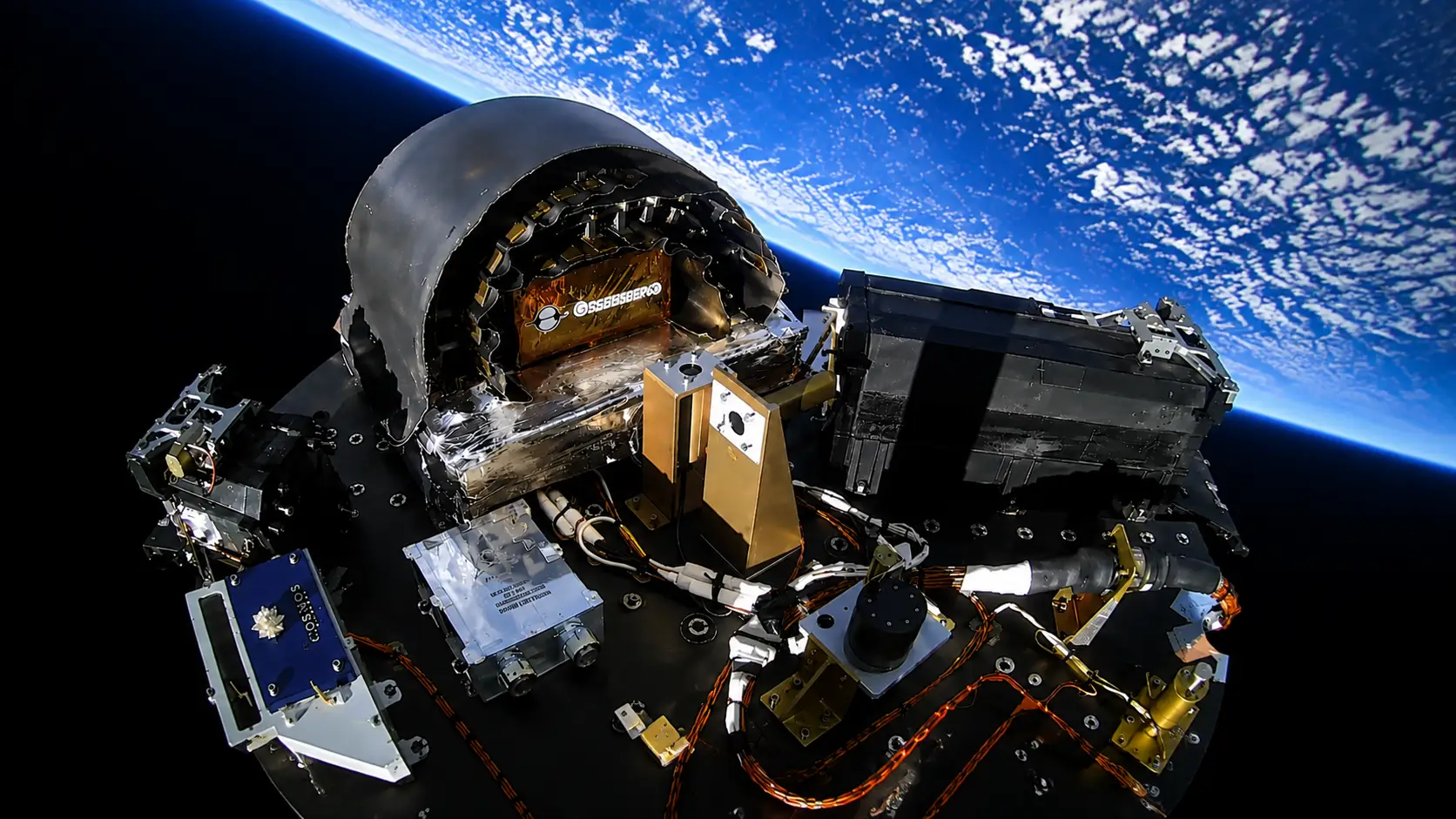
Hyderabad-based spacetech startup Cosmoserve Space has reported that its soft robotic capture system did not deploy as planned during its Mission Embrace demonstration aboard Skyroot Aerospace’s Vikram-1 rocket. The update comes after Vikram-1 successfully reached orbit on 18 July during its maiden orbital mission.
Cosmoserve’s experiment was designed to test a Venus flytrap-inspired robotic mechanism that could help capture defunct satellites and other non-cooperative objects in space. The company said the system performed successfully during ground testing and survived the stress of the launch, but the robotic petals failed to open after reaching the space environment.
Cosmoserve CEO Chiranjeevi Phanindra confirmed that the petals “could not open” due to conditions encountered during the mission. However, the company said the flight still provided valuable real-world data that could not have been collected through laboratory testing alone.
Mission Embrace was Cosmoserve’s first orbital technology demonstration and aimed to validate its soft robotic capture technology under conditions such as vacuum, temperature variations, and microgravity. The startup developed the payload in around four months and completed multiple stages, including system concept, preliminary design, critical design, and flight readiness reviews, before integrating it with Vikram-1’s orbital adjustment module stage.
Founded by a former ISRO scientist, Cosmoserve is developing a dual-spacecraft Active Debris Removal system to capture and remove space debris. The company claims its technology could enable such missions at around one-tenth the cost of comparable solutions.
The issue with Cosmoserve’s experiment did not affect Vikram-1’s overall mission success. Skyroot Aerospace’s rocket successfully launched from the Satish Dhawan Space Centre in Sriharikota at 12:05 p.m. IST after a 35-minute delay caused by a technical issue detected during the automated countdown.
Vikram-1 reached its planned 450-kilometre low Earth orbit approximately 16 minutes after liftoff, making Skyroot the first private Indian company to place a rocket into orbit. The achievement also made India the third country, after the United States and China, to have a private company capable of conducting orbital launches.
Cosmoserve is now analysing telemetry data from multiple ground stations to identify the reason behind the deployment failure and improve the technology for future missions. The Vikram-1 mission also carried other payloads, including Grahaa Space’s SOLARAS S3 cubesat and Skyroot’s SCOPE satellite for technology validation.
Skyroot Aerospace, which recently reached a valuation of $1.1 billion, plans to conduct another test flight later this year before beginning commercial launches in 2027.
Read Article: Anand Mahindra Says AI Will Deepen, Not Diminish, India’s IT Services Role