
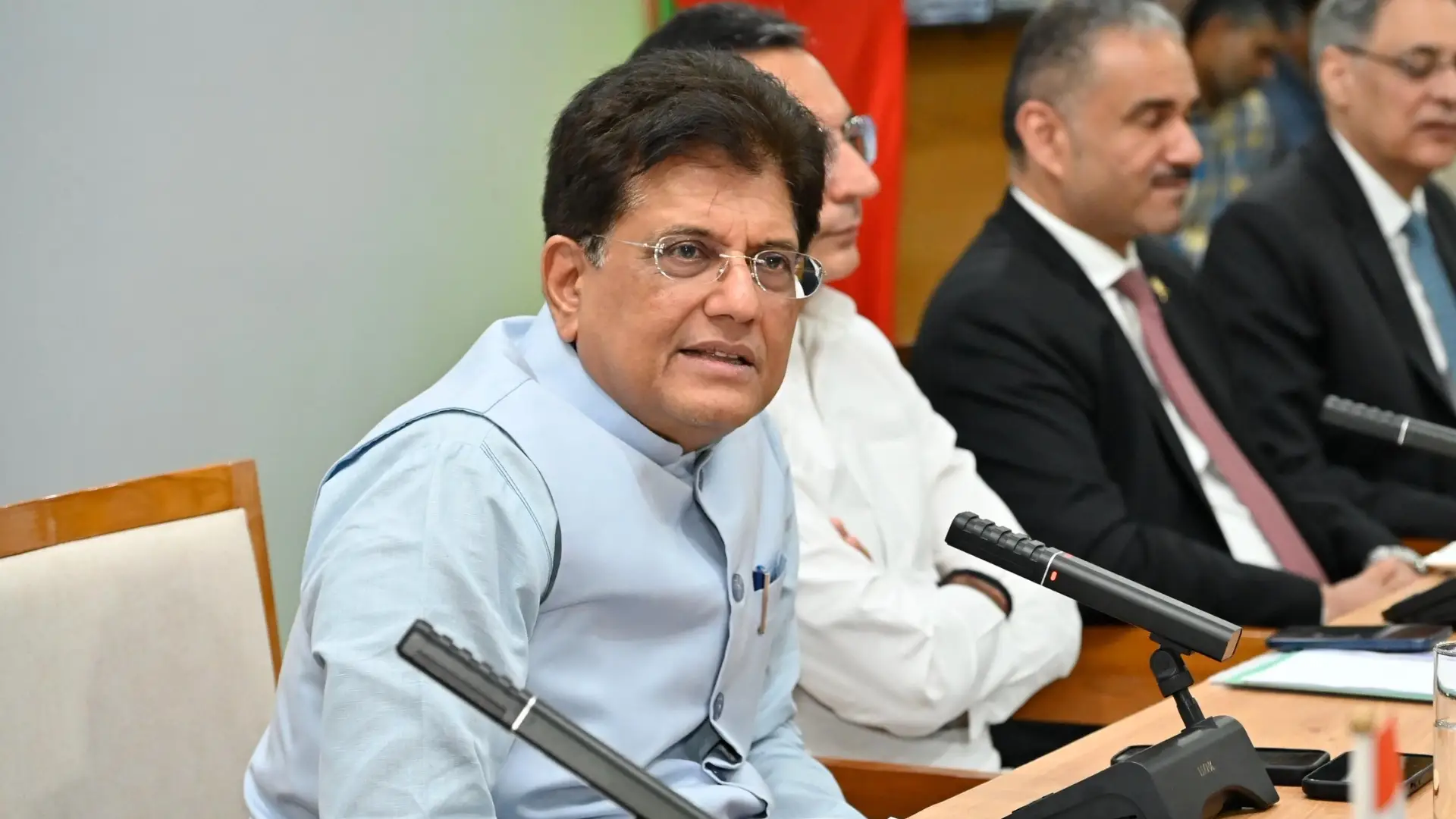
Union Commerce and Industry Minister Piyush Goyal has asserted that India is emerging as the world’s most trusted investment destination, telling global investors that the country is poised to remain the fastest-growing major economy for more than two decades. Speaking via a virtual address at the Citi India Conference 2026 in Mumbai, he said India has repeatedly turned crises into opportunities by reorienting its processes and business strategies to suit shifting geopolitical and economic conditions while staying attractive for trade, manufacturing and capital inflows.
Goyal drew on recent engagements in Canada and the United States to underline what he described as strong global confidence in India’s economic prospects. He said a visit to Canada with what he called the largest-ever Indian business delegation had yielded a positive response to a proposed India–Canada Free Trade Agreement and heightened interest from pension funds, insurance companies and other institutional investors. Meetings with leading investment firms and about 50 companies in New York reinforced a perception of India as the only credible alternative manufacturing hub, he added, citing factors such as democracy, rule of law, decisive leadership, technology capabilities and a consumer base of 1.4 billion people.
According to Goyal, the question before global investors is no longer whether to invest in India but how quickly they decide to participate. To illustrate the long-term value of manufacturing bets on India, he pointed to Hyundai’s 1999 entry with an investment of about USD 200 million and JCB’s expansion from early-stage infrastructure markets to exporting India-made products to nearly 130 countries while serving a growing domestic market. These examples, he said, demonstrate India’s ability to support manufacturing at scale for both local and global demand.
On trade policy, Goyal said India has signed nine Free Trade Agreements in the past three to three-and-a-half years, covering 38 developed economies, with a focus on expanding market access, easing trade, enabling movement of talent and attracting investments, including Global Capability Centres. He noted that the Oman FTA came into force on 1 June and indicated that two to three more substantial FTAs are expected to take effect within the next six months, with another three to four agreements likely in the following year. The government aims to operationalize all nine recently concluded FTAs over the next nine to ten months, he said.
Goyal also highlighted regulatory and structural reforms intended to improve the business climate. He cited the Jan Vishwas Act 2.0, passed in April, which decriminalizes nearly 1,000 offences across multiple central laws where there is no intent to cheat and no threat to public safety or health, framing it as a trust-based move to reduce compliance burdens and ease pressure on courts. He pointed to the Bhavya Scheme, with an outlay of nearly USD 3.5 billion, to develop 100 industrial parks with plug-and-play infrastructure including factory-ready units, worker housing, utilities, environmental clearances and digital connectivity, aimed at supporting MSMEs and manufacturers with the state acting as facilitator rather than regulator. He added that the consolidation of 29 labour laws into four labour codes, now activated with states beginning to adopt and amend their rules, has simplified compliance.
The Minister said India had successfully navigated recent global energy shocks by diversifying energy sources to ensure uninterrupted supplies of petrol, diesel, aviation fuel, LNG and LPG while keeping prices relatively moderate. Fertilizer prices for farmers have remained unchanged despite global increases, with the central government absorbing the cost, he said. Strong fiscal management over the past twelve years under Prime Minister Narendra Modi has enabled continued support for farmers, MSMEs, businesses and vulnerable sections while maintaining stability, according to Goyal.
On infrastructure, Goyal stated that India is investing nearly USD 130 billion in ports, highways, roads, rural connectivity and airports, and that port and airport capacities have doubled over the past decade. He referenced initiatives such as the Jal Jeevan Mission and a national power grid with 500 GW of installed capacity, with more than half of it from renewable sources, and said India plans to double renewable capacity from 250 GW to 500 GW in the next five years. He also highlighted a push into semiconductors and emerging technologies through large-scale reskilling and upskilling, noting that Tata and ASML are setting up India’s first capital equipment manufacturing facility for the semiconductor sector.
Goyal argued that global capital and technology are now flowing into India, not just Indian talent going abroad. He said India is moving beyond assembly-led manufacturing to innovation-led growth by backing design, research and development, artificial intelligence and indigenous technology stacks, including an Indian 5G stack, rapid 5G rollout, low-cost data, resilient power systems and a secure environment for data centres. He added that India offers a safe ecosystem with IP protection, technology security and data privacy, and said data centres serving global markets would enjoy income tax exemptions until 2047, the target year for India’s Viksit Bharat 2047 vision of becoming a developed USD 30 trillion economy. India, he concluded, offers “immense potential, possibility and profitability” through competitively produced high-quality goods and services, and he expressed confidence that, supported by 1.4 billion citizens and international partners, the country will become one of the defining growth stories of the 21st century.
Read Article: Larsen & Toubro to Invest ₹18,600 Crore in Tamil Nadu Across Three Major Projects