
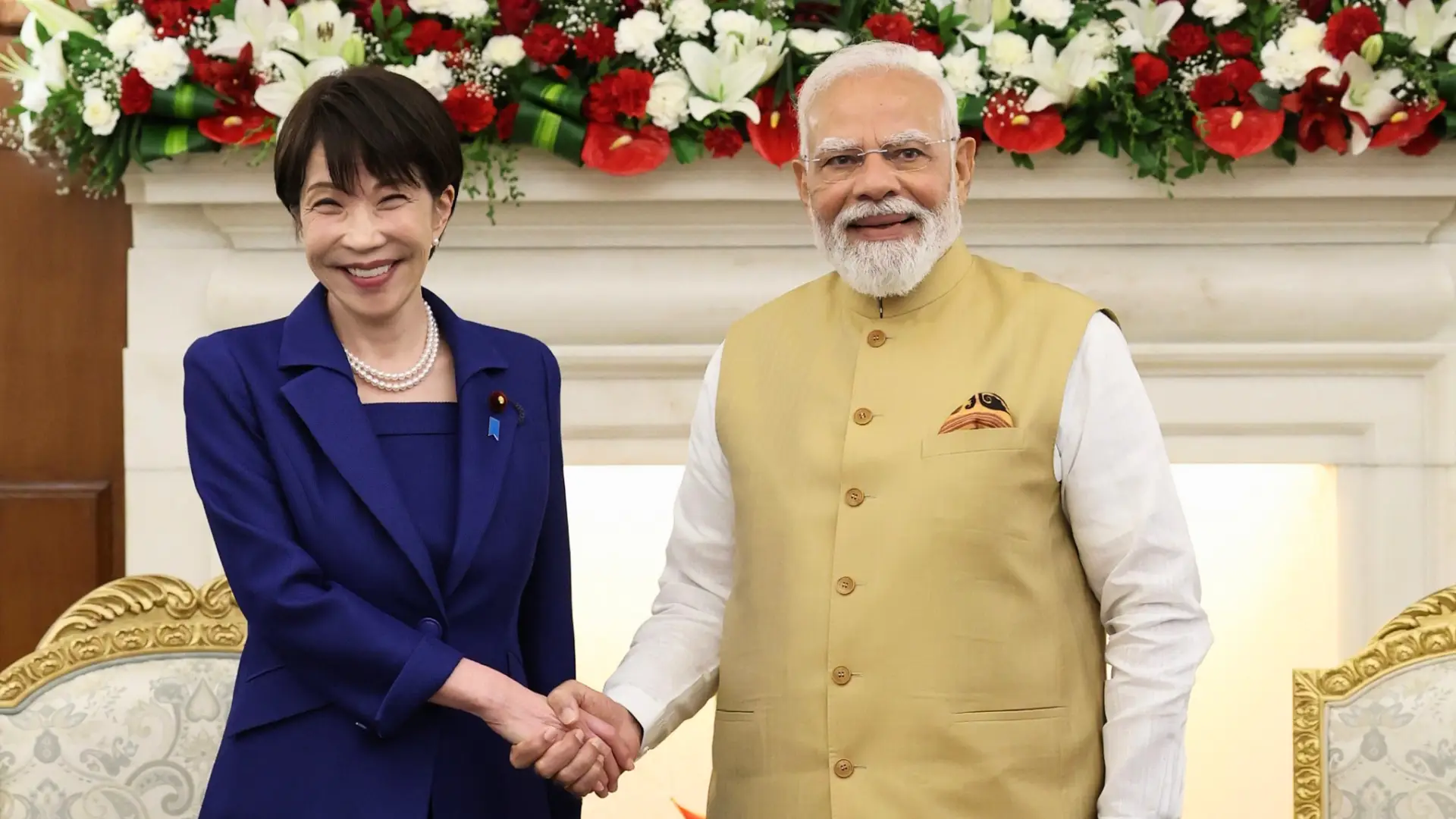
India and Japan have agreed on a broad agenda to deepen their partnership in economic security, technology, defence and clean energy following Japanese Prime Minister Sanae Takaichi’s first official visit to New Delhi for the 16th India-Japan Annual Summit. The two sides adopted key documents and oversaw multiple agreements that collectively seek to reinforce what both governments describe as a “special strategic and global partnership.”
During talks in New Delhi, Prime Minister Narendra Modi and Prime Minister Takaichi reviewed recent developments in the relationship and set out new areas of cooperation. The summit produced a Joint Declaration on Economic Security, a Joint Statement on Cooperation in the Field of Artificial Intelligence and a Joint Statement on Energy Resilience, signalling that economic and technological resilience will sit at the core of the next phase of ties. Officials framed these outcomes against a backdrop of evolving global challenges and a shared interest in safeguarding critical economic sectors.
Economic security was a central theme. The Joint Declaration commits both countries to deepen collaboration across government, industry and academia to build resilience in strategic sectors, enhance technology and infrastructure security and promote trusted and transparent frameworks. India and Japan have identified semiconductors, critical minerals, pharmaceuticals, clean energy and information and communication technology as priority areas for strategic cooperation, reflecting their desire to diversify supply chains and reduce reliance on a small number of suppliers. Foreign Secretary Vikram Misri said both sides agreed on the need to move away from dependence on single or very few sources and to develop strategic autonomy and resilience in these sectors.
Defence and security cooperation also featured prominently in the summit outcomes. Misri outlined plans to expand collaboration across land, air and naval systems, including unmanned platforms. The two countries reviewed progress on their ongoing naval radio antenna project and agreed to strengthen institutional defence dialogue through the India-Japan “2+2” ministerial mechanism that brings together their foreign and defence ministers. This builds on existing security ties and reflects a mutual interest in closer coordination on regional security and maritime issues, particularly in the Indo-Pacific.
Artificial intelligence emerged as another major pillar of the visit. The Joint Statement on AI cooperation emphasizes “safe, secure and trustworthy” development and deployment, mirroring concerns in both capitals about responsible innovation. New collaborations announced at the summit include partnerships between India’s Sarvam AI and Japan’s Preferred Networks on foundational AI models, and between IIT Bombay and Japan’s National Institute of Informatics to develop multilingual scientific large language models. These initiatives aim to link research institutions and startups across the two countries and advance work on next-generation AI applications with cross-border teams.
Energy resilience and clean technology formed a fourth major track. Under the Joint Statement on Energy Resilience, India and Japan agreed to cooperate on strategic petroleum reserves and maritime energy transport. The summit also launched the Japan-India Cooperative Biogas for Growth initiative, under which Japan will partner with India to establish 1,000 biogas plants across the country, combining waste-to-energy generation with production of organic fertilizer. Officials highlighted ongoing interest from Japanese companies in setting up rare earth permanent magnet facilities in India, linking energy and industrial policy with the broader critical minerals agenda.
The economic dimension of the relationship continues to expand alongside these strategic initiatives. Since the previous annual summit in Tokyo, more than 120 business-to-business agreements have been signed, representing investment commitments worth approximately $10 billion across semiconductors, green ammonia, finance, manufacturing and advanced technologies. The latest summit outcomes build on that trend by providing additional policy and institutional frameworks intended to support private-sector projects in these areas. Both sides see sustained industry-led engagement as central to translating high-level agreements into concrete investments and supply-chain diversification.
Taken together, the outcomes of Prime Minister Takaichi’s visit mark a comprehensive attempt to align India-Japan cooperation with emerging economic and technological priorities. With new instruments in economic security, AI governance, defence dialogue and energy resilience, the two governments have sought to update their partnership for an era defined by supply-chain risk, rapid technological change and contested strategic spaces in the Indo-Pacific. How quickly these frameworks turn into tangible projects across semiconductors, critical minerals, clean energy and digital infrastructure will now be a key point of focus for policymakers and businesses in both countries.
Read Article: HCLTech Lands $1.14 Billion AI Deal With Europe-Based Fortune Global 50 Company