
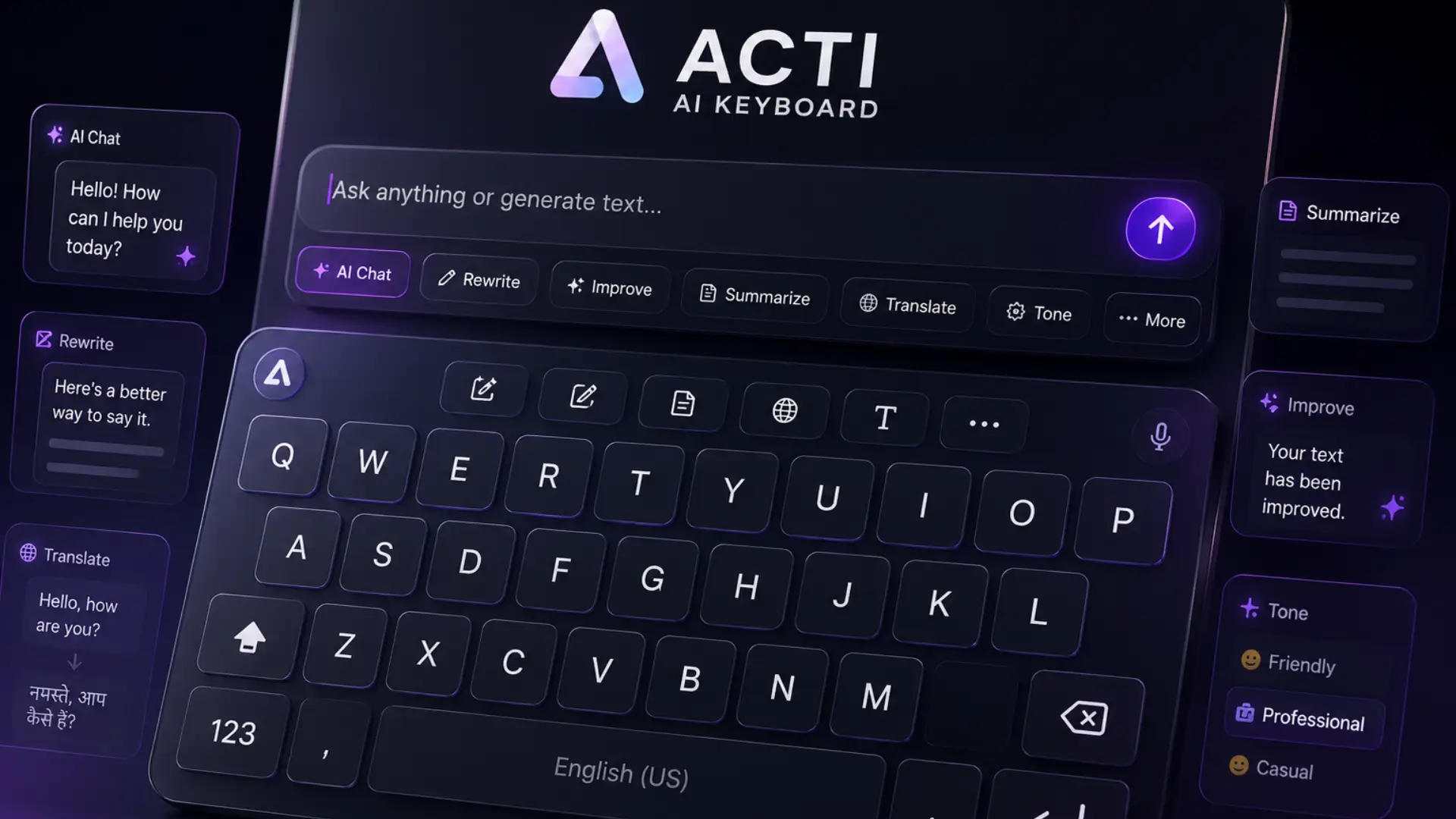
Singapore-based startup Acti has raised US$5.3 million in seed funding to build an AI-powered “agentic keyboard” that allows users to trigger shortcuts and actions directly from their smartphone keyboard. The company’s pitch is simple: instead of switching between apps to access AI, users can interact with AI agents from the place where they already spend most of their time typing.
Acti’s keyboard is available on both iOS and Android and is designed to work across messaging, email, social media, and other mobile apps. Users can create custom shortcuts, called Skills, by describing a task in plain English, enabling the keyboard to automate actions such as translating a message or sharing a meeting link.
What the keyboard does
The keyboard introduces an Acti Bar, which transforms the spacebar into an action trigger. Users can continue typing normally or hold the spacebar to execute actions such as sharing their location in a chat, opening a LinkedIn profile, finding nearby restaurants, or retrieving live sports information.
Acti also allows users to assign custom actions to individual keys through what it calls Skill Keys. With a single long press, users can open a Notion document, launch a Google Meet link, or trigger a calendar workflow without leaving their conversation. According to the company, these shortcuts can either remain private or be shared with others through a community marketplace.
Why the company matters
Acti aims to solve a common usability problem: AI tools are often separated from the apps where people actually communicate and work. Young Wang, Acti’s founder and CEO, argues that the keyboard is the ideal place to build an AI context layer because it works across virtually every app and can convert user intent into action without requiring users to switch between applications.
That positioning is significant because it reimagines the keyboard as more than just a typing utility. In Acti’s vision, the keyboard becomes a universal workflow interface capable of embedding AI-powered actions directly into everyday interactions.
Acti says its platform is powered by Google’s Gemini models, which were chosen for their intelligence, speed, reliability, multilingual capabilities, and cost efficiency. The company also follows a local-first architecture, meaning personal context remains on the device unless a specific feature explicitly requires cloud processing.
This privacy-focused approach is particularly important because smartphone keyboards can access highly sensitive information, including messages, search queries, and personal context. Acti says it does not store private messages or personal context unless users intentionally invoke a feature that requires that information.
Funding and traction
The startup’s US$5.3 million seed round was led by BITKRAFT Ventures, according to launch reports.
Acti says early-access users created more than 1,000 custom Skills within the first two weeks, suggesting strong early interest in its shortcut-building feature. The company plans to monetize the platform through subscription plans that provide access to more advanced AI models, higher usage limits, and additional premium features.
Read Article: Government Examines WhatsApp Usernames Feature Amid Fraud Concerns